Touch and changeToca y cambia
Move, type, tap, or drag in the model. Watch what changes.Mueve, escribe, toca o arrastra en el modelo. Observa qué cambia.
Unit 9 · 6.NOS.7
Ordered Pairs in All Four Quadrants · Lesson 9-5
English: Use the pictures and short steps. Ask questions; let your student do the thinking. Español: Usen los dibujos y los pasos cortos. Hagan preguntas; dejen que su estudiante piense.
Tonight we plot points in all four parts of the grid, called quadrants. Now the numbers can be negative, which means left or down.
Esta noche marcamos puntos en las cuatro partes de la cuadrícula, llamadas cuadrantes. Ahora los números pueden ser negativos, lo que significa a la izquierda o hacia abajo.
Follow the picture pathSigan la ruta visual
Real example: a treasure clue is at (-3, -4).
Ejemplo real: una pista del tesoro está en (-3, -4).
We start at the origin (0, 0) in the center.
Empezamos en el origen (0, 0), en el centro.
The first number is -3.
El primer número es -3.
It is negative, so move 3 units to the LEFT (not right).
Es negativo, así que muévete 3 unidades a la IZQUIERDA (no a la derecha).
The second number is -4.
El segundo número es -4.
It is negative, so move 4 units DOWN (not up). Place the dot.
Es negativo, así que muévete 4 unidades hacia ABAJO (no hacia arriba). Pon el punto.
Both numbers are negative (left and down), so the point lands in Quadrant III.
Ambos números son negativos (izquierda y abajo), así que el punto cae en el Cuadrante III.
Listen for "coordenada negativa" — it means a number less than zero, so you move left or down from the center.
Escucha "coordenada negativa" — significa un número menor que cero, así que te mueves a la izquierda o hacia abajo desde el centro.
Listen for "cuadrante" — the four parts of the grid, numbered I, II, III, and IV.
Escucha "cuadrante" — las cuatro partes de la cuadrícula, numeradas I, II, III y IV.
Let your student try first. Ask "Does the sign tell us to go left or right? Up or down?" before helping.
Deja que tu estudiante intente primero. Pregunta "¿El signo nos dice ir a la izquierda o a la derecha? ¿Arriba o abajo?" antes de ayudar.
Use the same interactive model from the lesson. Change it, notice the pattern, and explain what the model shows.Usa el mismo modelo interactivo de la lección. Cámbialo, observa el patrón y explica lo que muestra.
Move, type, tap, or drag in the model. Watch what changes.Mueve, escribe, toca o arrastra en el modelo. Observa qué cambia.
Record one equation, value, or relationship you can see.Escribe una ecuación, un valor o una relación que puedas ver.
I notice ___ changes when ___ changes. This shows ___.Noto que ___ cambia cuando ___ cambia. Esto muestra ___.
The signs of (x, y) tell you the quadrant: (+,+) is I, (-,+) is II, (-,-) is III, (+,-) is IV.
A quick, no-timer review game for tonight's lesson — sort, match, and choose. A wrong answer just gives a hint and lets your student try again. Un juego de repaso sin reloj para la lección de hoy — clasificar, emparejar y elegir. Si se equivocan, reciben una pista y pueden intentar de nuevo.
↗ Play full screen ↗ Jugar en pantalla completa
Tap a card to flip. Use these words when you talk about the math together. Toquen una tarjeta para voltearla. Usen estas palabras cuando hablen de la matemática juntos.
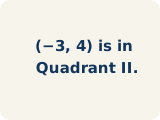
Pares ordenados en los cuatro cuadrantes
Points written as (x, y) whose positive or negative coordinates place them in one of four quadrants.
Puntos escritos como (x, y) cuyas coordenadas positivas o negativas los ubican en uno de cuatro cuadrantes.
📌 (−3, 4) is in Quadrant II.
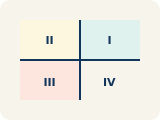
Cuadrante
One of the four parts of a coordinate grid, numbered I to IV.
Una de las cuatro partes de una cuadrícula de coordenadas, numeradas I a IV.
📌 I (+, +) top-right, II (-, +) top-left, III (-, -) bottom-left, IV (+, -) bottom-right
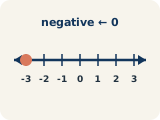
Coordenada negativa
A coordinate less than zero. It means left or below the center point.
Una coordenada menor que cero. Significa a la izquierda o debajo del centro.
📌 (-3, 2) means 3 left and 2 up from the origin
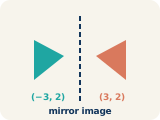
Reflexión
A flipped, mirror image across a line.
Una imagen reflejada al otro lado de una línea.
📌 (3, 2) reflected over the y-axis is (-3, 2) — same distance, opposite side
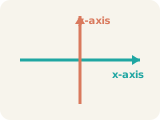
Eje
A line on the grid. The x-axis goes across; the y-axis goes up.
Una línea en la cuadrícula. El eje x va de lado; el eje y va hacia arriba.
📌 The x-axis goes left-right; the y-axis goes up-down; they cross at (0, 0)
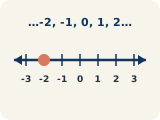
Número entero
Whole numbers and their opposites, like -2, -1, 0, 1, 2.
Números enteros y sus opuestos, como -2, -1, 0, 1, 2.
📌 ..., -3, -2, -1, 0, 1, 2, 3, ...
Captain Vega's next clue is at (-5, 2): west and north of base camp. Plot it together.
La siguiente pista de la capitana Vega está en (-5, 2): al oeste y al norte del campamento base. Márquenla juntos.
Work side by side. You ask questions; your student does the thinking. Trabajen juntos. Tú haces preguntas; tu estudiante piensa.
The first number is -5. Which way do we move? Left 5 units, because it is negative.
El primer número es -5. ¿Hacia dónde nos movemos? A la izquierda 5 unidades, porque es negativo.
The second number is 2. It is positive, so move up 2 units and place the dot.
El segundo número es 2. Es positivo, así que muévanse hacia arriba 2 unidades y pongan el punto.
Left and up — which quadrant is that? Quadrant II.
Izquierda y arriba — ¿qué cuadrante es ese? El Cuadrante II.
Do these together. Start at ★ and climb to ★★★ when ready. Háganlos juntos. Empiecen en ★ y suban a ★★★ cuando estén listos.
In which quadrant is the point (-4, 5)?
B. Quadrant II
A point has a positive x-coordinate and a negative y-coordinate. Which quadrant is it in?
D. Quadrant IV
Point A is at (-5, 3). If you move 8 units to the right, what are the new coordinates?
A. (3, 3)
In which quadrant is the point (-3, 5)?
B. Quadrant II
A point starts in Quadrant I at (4, 6). Describe a move that puts it in Quadrant III. What must happen to both coordinates? Can you give the exact new coordinates after your move?
⏱️ Plan on about 15–20 minutes for the 6 problems below. The extra practice at the bottom is optional. ⏱️ Calculen unos 15–20 minutos para los 6 problemas de abajo. La práctica extra al final es opcional.
A few problems to practice together. Each one has a step-by-step guide, a picture to draw on, and a space to show your work. Use Check This Problem for instant feedback — no need to finish everything at once. Unos problemas para practicar juntos. Cada uno tiene una guía paso a paso, un dibujo para trabajar y un espacio para mostrar el trabajo. Usen Revisar esta pregunta para retroalimentación al instante — no tienen que terminar todo de una vez.
Easier problems to practice the idea. Do these first together. Problemas más fáciles para practicar la idea. Hagan estos primero juntos.
A point has a positive x-coordinate and a negative y-coordinate. Which quadrant is it in?Un punto tiene la coordenada x positiva y la coordenada y negativa. ¿En qué cuadrante está?
👪 Read the question together, then let your student pick an answer before you discuss why.👪 Lean la pregunta juntos; dejen que su estudiante elija antes de hablar del porqué.
Sort these points by their quadrant: I first, then II, III, IV.Clasifica estos puntos por su cuadrante: primero I, después II, III, IV.
👪 Use the ▲ ▼ buttons to reorder steps, or drag the row handles on a computer.👪 Usen ▲ ▼ para reordenar, o arrastren las filas en la computadora.
For each ordered pair, write the signs of x and y and name the quadrant (or axis).Para cada par ordenado, escribe los signos de x y y, y nombra el cuadrante (o el eje).
👪 Encourage your student to show work on paper if a box feels tricky.👪 Animen a mostrar el trabajo en papel si una casilla se siente difícil.
| Point | x sign | y sign | Quadrant or Axis |
|---|---|---|---|
| (6, -2) |
|
|
|
| (-3, -5) |
|
|
|
| (0, 7) |
|
|
|
| (-1, 8) |
|
|
|
| (4, 0) |
|
|
|
Try these once the warm-up feels easy. It's okay to use the steps and pictures. Intenten estos cuando el calentamiento sea fácil. Está bien usar los pasos y los dibujos.
A point starts in Quadrant I at (4, 6). Describe a move that puts it in Quadrant III. What must happen to both coordinates? Can you give the exact new coordinates after your move?Un punto empieza en el cuadrante I en (4, 6). Describe un movimiento que lo lleve al cuadrante III. ¿Qué debe pasar con las dos coordenadas? ¿Puedes dar las coordenadas nuevas exactas después de tu movimiento?
👪 A complete sentence with math vocabulary is the goal — not a perfect paragraph.👪 Una oración completa con vocabulario matemático es la meta — no un párrafo perfecto.
Captain Vega spotted four enemy ships. Drag each ship's coordinates into the correct quadrant of the map.La capitana Vega vio cuatro barcos enemigos. Arrastra las coordenadas de cada barco al cuadrante correcto del mapa.
👪 On a phone, use Move to. On a computer, drag cards or tap a card then tap a column.👪 En el teléfono usen Mover a. En la computadora arrastren o toquen tarjeta y columna.
Reflecting the point (3, -6) across the x-axis gives which point?Reflejar el punto (3, -6) sobre el eje x da como resultado ¿cuál punto?
👪 Read the question together, then let your student pick an answer before you discuss why.👪 Lean la pregunta juntos; dejen que su estudiante elija antes de hablar del porqué.
Optional. Only if your student wants more — these are bonus problems. Opcional. Solo si tu estudiante quiere más — son problemas adicionales.
Match each ordered pair to its quadrant.Une cada par ordenado con su cuadrante.
👪 Say each term out loud, then talk through which match makes sense before choosing.👪 Digan cada término en voz alta y hablen de cuál pareja tiene sentido antes de elegir.
Match each quadrant to its coordinate sign pattern.Une cada cuadrante con su patrón de signos de coordenadas.
👪 Say each term out loud, then talk through which match makes sense before choosing.👪 Digan cada término en voz alta y hablen de cuál pareja tiene sentido antes de elegir.
Captain Vega's lookout reports a ship in Quadrant II. What signs will its coordinates (x, y) have?El vigía de la capitana Vega reporta un barco en el cuadrante II. ¿Qué signos tendrán sus coordenadas (x, y)?
👪 Read the question together, then let your student pick an answer before you discuss why.👪 Lean la pregunta juntos; dejen que su estudiante elija antes de hablar del porqué.
Match each enemy ship's coordinates to the quadrant where Captain Vega should fire.Une las coordenadas de cada barco enemigo con el cuadrante donde debe disparar la capitana Vega.
👪 Say each term out loud, then talk through which match makes sense before choosing.👪 Digan cada término en voz alta y hablen de cuál pareja tiene sentido antes de elegir.
In which quadrant is the point (-4, 5)?¿En qué cuadrante está el punto (-4, 5)?
👪 Read the question together, then let your student pick an answer before you discuss why.👪 Lean la pregunta juntos; dejen que su estudiante elija antes de hablar del porqué.
Point A is at (-5, 3). If you move 8 units to the right, what are the new coordinates?El punto A está en (-5, 3). Si te mueves 8 unidades a la derecha, ¿cuáles son las nuevas coordenadas?
👪 Read the question together, then let your student pick an answer before you discuss why.👪 Lean la pregunta juntos; dejen que su estudiante elija antes de hablar del porqué.
In which quadrant is the point (-3, 5)?¿En qué cuadrante está el punto (-3, 5)?
👪 Read the question together, then let your student pick an answer before you discuss why.👪 Lean la pregunta juntos; dejen que su estudiante elija antes de hablar del porqué.
What are the coordinates of a point 4 units right and 2 units down from the origin?¿Cuáles son las coordenadas de un punto que está 4 unidades a la derecha y 2 unidades hacia abajo desde el origen?
👪 Read the question together, then let your student pick an answer before you discuss why.👪 Lean la pregunta juntos; dejen que su estudiante elija antes de hablar del porqué.
A digital scratch pad to draw models, line up decimals, and show your work. It opens in a new tab so you keep your place on this homework. Una pizarra digital para dibujar modelos, alinear decimales y mostrar el trabajo. Se abre en una pestaña nueva para no perder tu lugar en esta tarea.
🧮 Open the Math Workbench ↗ 🧮 Abrir la Pizarra de matemáticas ↗
Is the first number positive or negative? Does that mean left or right?
¿El primer número es positivo o negativo? ¿Eso significa izquierda o derecha?
Is the second number positive or negative? Does that mean up or down?
¿El segundo número es positivo o negativo? ¿Eso significa arriba o abajo?
We always start at the center, the origin. Put your finger there first.
Siempre empezamos en el centro, el origen. Pon el dedo ahí primero.
A negative sign just means the same direction, right and up.
Un signo negativo solo significa la misma dirección, a la derecha y hacia arriba.
Ignore the negative signs and plot the point in Quadrant I.
Ignora los signos negativos y marca el punto en el Cuadrante I.
The order of the numbers does not matter anymore with negatives.
El orden de los números ya no importa con los negativos.
These links go to specific videos and lessons about tonight's topic — not general math pages. Estos enlaces van a videos y lecciones específicas sobre el tema de hoy — no páginas generales.
Reinforce tonight's topic with a quick family game. You ask; your student decides! Refuercen el tema de hoy con un juego rápido en familia. ¡Ustedes preguntan; su estudiante decide!
🎮 Play together! Go right for x, up for y. Play together on the grid! 🎮 ¡Jueguen juntos! Derecha es x, arriba es y. ¡Jueguen juntos en la cuadrícula!
High five! Whether every answer was perfect or not, you showed up for your student tonight. That matters.
¡Chócalas! No importa si cada respuesta fue perfecta — estuviste con tu estudiante esta noche. Eso importa.
Answers save automatically on this device. Tap Check This Problem anytime. Las respuestas se guardan solas en este dispositivo. Toquen Revisar esta pregunta cuando quieran.
Signed on:Firmado el:
Note to teacher / Nota para el maestro:
This certifies that the homework for was completed and reviewed collaboratively.
Parent/Guardian Signature
Date