Touch and changeToca y cambia
Move, type, tap, or drag in the model. Watch what changes.Mueve, escribe, toca o arrastra en el modelo. Observa qué cambia.
Unit 10 · 6.GR.4
Surface Area Using Nets · Lesson 10-3
English: Use the pictures and short steps. Ask questions; let your student do the thinking. Español: Usen los dibujos y los pasos cortos. Hagan preguntas; dejen que su estudiante piense.
Tonight we find the surface area of a box — how much paper it takes to cover the outside. We unfold the box into a flat net and add up all six faces.
Esta noche encontramos el área de superficie de una caja — cuánto papel se necesita para cubrir el exterior. Desdoblamos la caja en una plantilla plana y sumamos las seis caras.
Follow the picture pathSigan la ruta visual
Real example: a box is 8 long, 5 wide, and 3 tall.
Ejemplo real: una caja mide 8 de largo, 5 de ancho y 3 de alto.
We unfold it into a net and see 3 pairs of faces.
La desdoblamos en una plantilla y vemos 3 pares de caras.
Top and bottom: each is 8 × 5 = 40.
Arriba y abajo: cada una es 8 × 5 = 40.
There are 2, so 2 × 40 = 80.
Hay 2, así que 2 × 40 = 80.
Front and back: each is 8 × 3 = 24, so 2 × 24 = 48.
Frente y atrás: cada una es 8 × 3 = 24, así que 2 × 24 = 48.
Left and right: each is 5 × 3 = 15, so 2 × 15 = 30.
Izquierda y derecha: cada una es 5 × 3 = 15, así que 2 × 15 = 30.
Add all three pairs: 80 + 48 + 30 = 158.
Suma los tres pares: 80 + 48 + 30 = 158.
So the surface area is 158 square inches (in²).
Así que el área de superficie es 158 pulgadas cuadradas (in²).
Listen for "área de superficie" — it means the total area of all the flat sides, like wrapping paper.
Escucha "área de superficie" — significa el área total de todos los lados planos, como papel de regalo.
Listen for "plantilla" (the net) — the flat shape you get when you unfold the box.
Escucha "plantilla" (el desarrollo plano) — la figura plana que se forma al desdoblar la caja.
Let your student try first. Ask "How many faces does the box have?" The answer is 6.
Deja que tu estudiante intente primero. Pregunta "¿Cuántas caras tiene la caja?" La respuesta es 6.
Use the same interactive model from the lesson. Change it, notice the pattern, and explain what the model shows.Usa el mismo modelo interactivo de la lección. Cámbialo, observa el patrón y explica lo que muestra.
Move, type, tap, or drag in the model. Watch what changes.Mueve, escribe, toca o arrastra en el modelo. Observa qué cambia.
Record one equation, value, or relationship you can see.Escribe una ecuación, un valor o una relación que puedas ver.
I notice ___ changes when ___ changes. This shows ___.Noto que ___ cambia cuando ___ cambia. Esto muestra ___.
A box has 3 pairs of matching faces, so add up all 6 faces to get the surface area.
A quick, no-timer review game for tonight's lesson — sort, match, and choose. A wrong answer just gives a hint and lets your student try again. Un juego de repaso sin reloj para la lección de hoy — clasificar, emparejar y elegir. Si se equivocan, reciben una pista y pueden intentar de nuevo.
↗ Play full screen ↗ Jugar en pantalla completa
Tap a card to flip. Use these words when you talk about the math together. Toquen una tarjeta para voltearla. Usen estas palabras cuando hablen de la matemática juntos.
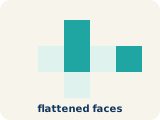
Área de superficie usando redes
The total area of every face of a three-dimensional figure, found by adding the faces shown in its net.
El área total de todas las caras de una figura tridimensional, que se halla sumando las caras mostradas en su red.
📌 Surface area = area of face 1 + face 2 + every remaining face.
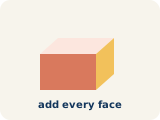
Área de superficie
The total area of all the flat sides of a solid.
El área total de todos los lados planos de un sólido.
📌 A box 6 × 4 × 2: SA = 2(24) + 2(12) + 2(8) = 88 in² — like wrapping paper needed
Plantilla (desarrollo plano)
A flat shape that folds up into a solid.
Una figura plana que se dobla y forma un sólido.
📌 Cut along the edges of a cereal box and unfold it flat — you see all 6 faces
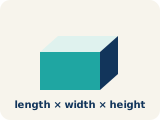
Cara
One flat side of a solid shape.
Un lado plano de una figura sólida.
📌 A rectangular prism has 6 faces: top, bottom, front, back, left, right
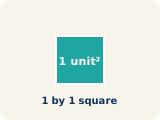
Bidimensional
A flat shape with length and width, but no thickness.
Una figura plana con largo y ancho, pero sin grosor.
📌 A rectangle drawn on paper is 2D — it has length and width but no depth
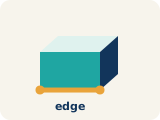
Arista
The line where two flat sides of a solid meet.
La línea donde se unen dos lados planos de un sólido.
📌 A cube has 12 edges — the lines where two flat faces connect
Find the surface area of a smaller box that is 4 long, 3 wide, and 2 tall.
Encuentren el área de superficie de una caja más pequeña que mide 4 de largo, 3 de ancho y 2 de alto.
Work side by side. You ask questions; your student does the thinking. Trabajen juntos. Tú haces preguntas; tu estudiante piensa.
Top and bottom: 4 × 3 = 12, times 2 = 24.
Arriba y abajo: 4 × 3 = 12, por 2 = 24.
Front and back: 4 × 2 = 8, times 2 = 16. Left and right: 3 × 2 = 6, times 2 = 12.
Frente y atrás: 4 × 2 = 8, por 2 = 16. Izquierda y derecha: 3 × 2 = 6, por 2 = 12.
Add all three pairs: 24 + 16 + 12 = 52. So the surface area is 52 square inches.
Sumen los tres pares: 24 + 16 + 12 = 52. Así que el área de superficie es 52 pulgadas cuadradas.
Do these together. Start at ★ and climb to ★★★ when ready. Háganlos juntos. Empiecen en ★ y suban a ★★★ cuando estén listos.
A rectangular prism has l = 6 in, w = 4 in, h = 2 in. What is its surface area?
A. 88 in²
How many faces does a rectangular prism have?
A. 6
A cube has edges of 5 cm. What is its surface area?
A. 150 cm²
You unfold a time capsule that is a cube. Its net shows 6 equal squares, and each square has an area of 4 cm². What is the cube's total surface area?
A. 24 cm²
Two boxes have the same volume of 60 in³. Box A is 5 × 4 × 3. Box B is 10 × 6 × 1. Which box uses less wrapping paper (has less surface area)? Show your calculations and explain why a more cube-like shape might use less material.
⏱️ Plan on about 15–20 minutes for the 6 problems below. The extra practice at the bottom is optional. ⏱️ Calculen unos 15–20 minutos para los 6 problemas de abajo. La práctica extra al final es opcional.
A few problems to practice together. Each one has a step-by-step guide, a picture to draw on, and a space to show your work. Use Check This Problem for instant feedback — no need to finish everything at once. Unos problemas para practicar juntos. Cada uno tiene una guía paso a paso, un dibujo para trabajar y un espacio para mostrar el trabajo. Usen Revisar esta pregunta para retroalimentación al instante — no tienen que terminar todo de una vez.
Easier problems to practice the idea. Do these first together. Problemas más fáciles para practicar la idea. Hagan estos primero juntos.
Match each solid to the net it folds up from.Une cada sólido con la plantilla con la que se arma.
👪 Say each term out loud, then talk through which match makes sense before choosing.👪 Digan cada término en voz alta y hablen de cuál pareja tiene sentido antes de elegir.
Sort each flat shape: is it a valid net that folds into a closed time capsule box, or not a complete net?Clasifica cada figura plana: ¿es una plantilla válida que se dobla para formar una caja cerrada de cápsula del tiempo, o no es una plantilla completa?
👪 On a phone, use Move to. On a computer, drag cards or tap a card then tap a column.👪 En el teléfono usen Mover a. En la computadora arrastren o toquen tarjeta y columna.
A time capsule box measures 2 in × 3 in × 4 in. Using its net, you add up all six faces. What is the total surface area?Una caja de cápsula del tiempo mide 2 in × 3 in × 4 in. Usando su desarrollo plano, sumas las seis caras. ¿Cuál es el área total de la superficie?
👪 Read the question together, then let your student pick an answer before you discuss why.👪 Lean la pregunta juntos; dejen que su estudiante elija antes de hablar del porqué.
Try these once the warm-up feels easy. It's okay to use the steps and pictures. Intenten estos cuando el calentamiento sea fácil. Está bien usar los pasos y los dibujos.
Your team unfolds a rectangular time capsule box into a flat net. How many faces (flat sides) will the net show in all?Tu equipo desdobla una caja rectangular de cápsula del tiempo para formar un desarrollo plano. ¿Cuántas caras (lados planos) mostrará el desarrollo en total?
👪 Read the question together, then let your student pick an answer before you discuss why.👪 Lean la pregunta juntos; dejen que su estudiante elija antes de hablar del porqué.
Two boxes have the same volume of 60 in³. Box A is 5 × 4 × 3. Box B is 10 × 6 × 1. Which box uses less wrapping paper (has less surface area)? Show your calculations and explain why a more cube-like shape might use less material.Dos cajas tienen el mismo volumen de 60 in³. La caja A mide 5 × 4 × 3. La caja B mide 10 × 6 × 1. ¿Cuál caja usa menos papel de envolver (tiene menos área superficial)? Muestra tus cálculos y explica por qué una forma más parecida a un cubo puede usar menos material.
👪 A complete sentence with math vocabulary is the goal — not a perfect paragraph.👪 Una oración completa con vocabulario matemático es la meta — no un párrafo perfecto.
You unfold a time capsule that is a cube. Its net shows 6 equal squares, and each square has an area of 4 cm². What is the cube's total surface area?Desdoblas una cápsula del tiempo que tiene forma de cubo. Su desarrollo plano muestra 6 cuadrados iguales, y cada cuadrado tiene un área de 4 cm². ¿Cuál es el área total de la superficie del cubo?
👪 Read the question together, then let your student pick an answer before you discuss why.👪 Lean la pregunta juntos; dejen que su estudiante elija antes de hablar del porqué.
Optional. Only if your student wants more — these are bonus problems. Opcional. Solo si tu estudiante quiere más — son problemas adicionales.
Put these steps in order for finding the surface area of a 5 × 3 × 2 box.Ordena estos pasos para encontrar el área superficial de una caja de 5 × 3 × 2.
👪 Use the ▲ ▼ buttons to reorder steps, or drag the row handles on a computer.👪 Usen ▲ ▼ para reordenar, o arrastren las filas en la computadora.
Match each concept about rectangular prisms.Une cada concepto sobre los prismas rectangulares.
👪 Say each term out loud, then talk through which match makes sense before choosing.👪 Digan cada término en voz alta y hablen de cuál pareja tiene sentido antes de elegir.
A rectangular prism has l = 6 in, w = 4 in, h = 2 in. What is its surface area?Un prisma rectangular tiene l = 6 in, w = 4 in, h = 2 in. ¿Cuál es el área de su superficie?
👪 Read the question together, then let your student pick an answer before you discuss why.👪 Lean la pregunta juntos; dejen que su estudiante elija antes de hablar del porqué.
Find the surface area of each time capsule box using its net.Encuentra el área superficial de cada caja de cápsula del tiempo usando su plantilla.
👪 Encourage your student to show work on paper if a box feels tricky.👪 Animen a mostrar el trabajo en papel si una casilla se siente difícil.
| Box | Length | Width | Height | Surface Area |
|---|---|---|---|---|
| Box A | 10 in | 6 in | 4 in |
|
| Box B | 7 cm | 7 cm | 3 cm |
|
| Box C | 12 ft | 5 ft | 2 ft |
|
A cube has edges of 5 cm. What is its surface area?Un cubo tiene aristas de 5 cm. ¿Cuál es el área de su superficie?
👪 Read the question together, then let your student pick an answer before you discuss why.👪 Lean la pregunta juntos; dejen que su estudiante elija antes de hablar del porqué.
Surface area is measured in which type of unit?¿Con qué tipo de unidad se mide el área de la superficie?
👪 Read the question together, then let your student pick an answer before you discuss why.👪 Lean la pregunta juntos; dejen que su estudiante elija antes de hablar del porqué.
Sort these rectangular prisms from LEAST surface area to GREATEST surface area.Ordena estos prismas rectangulares del MENOR área superficial al MAYOR área superficial.
👪 Use the ▲ ▼ buttons to reorder steps, or drag the row handles on a computer.👪 Usen ▲ ▼ para reordenar, o arrastren las filas en la computadora.
Compare volume and surface area. Which measurement is bigger for each prism?Compara el volumen y el área superficial. ¿Cuál medida es mayor en cada prisma?
👪 Encourage your student to show work on paper if a box feels tricky.👪 Animen a mostrar el trabajo en papel si una casilla se siente difícil.
| Prism | Volume (cubic units) | Surface Area (square units) | Which is numerically larger? |
|---|---|---|---|
| 2 × 2 × 2 |
|
|
|
| 5 × 5 × 5 |
|
|
|
| 10 × 10 × 10 |
|
|
|
A digital scratch pad to draw models, line up decimals, and show your work. It opens in a new tab so you keep your place on this homework. Una pizarra digital para dibujar modelos, alinear decimales y mostrar el trabajo. Se abre en una pestaña nueva para no perder tu lugar en esta tarea.
🧮 Open the Math Workbench ↗ 🧮 Abrir la Pizarra de matemáticas ↗
How many faces does the box have? Let's find each one.
¿Cuántas caras tiene la caja? Busquemos cada una.
Each face has a matching face. Did we double every pair?
Cada cara tiene una cara igual. ¿Duplicamos cada par?
What units should the answer have — square or cubic?
¿Qué unidades debe tener la respuesta — cuadradas o cúbicas?
Just multiply the three edges together.
Solo multiplica las tres aristas.
A box only has 5 faces, so count five.
Una caja solo tiene 5 caras, así que cuenta cinco.
You only need to count one face from each pair.
Solo necesitas contar una cara de cada par.
These links go to specific videos and lessons about tonight's topic — not general math pages. Estos enlaces van a videos y lecciones específicas sobre el tema de hoy — no páginas generales.
Reinforce tonight's topic with a quick family game. You ask; your student decides! Refuercen el tema de hoy con un juego rápido en familia. ¡Ustedes preguntan; su estudiante decide!
🎮 Play together! Add up every face you see on the net. 🎮 ¡Jueguen juntos! Sumen cada cara que ven en la red.
High five! Whether every answer was perfect or not, you showed up for your student tonight. That matters.
¡Chócalas! No importa si cada respuesta fue perfecta — estuviste con tu estudiante esta noche. Eso importa.
Answers save automatically on this device. Tap Check This Problem anytime. Las respuestas se guardan solas en este dispositivo. Toquen Revisar esta pregunta cuando quieran.
Signed on:Firmado el:
Note to teacher / Nota para el maestro:
This certifies that the homework for was completed and reviewed collaboratively.
Parent/Guardian Signature
Date