Touch and changeToca y cambia
Choose two factors that multiply to the number in the circle.Elige dos factores cuyo producto sea el número del círculo.
Unit 1 · 6.NOS.4
Greatest Common Factor · Lesson 1-2
English: Use the pictures and short steps. Ask questions; let your student do the thinking. Español: Usen los dibujos y los pasos cortos. Hagan preguntas; dejen que su estudiante piense.
Tonight we find the greatest common factor (GCF) of two numbers. It is the biggest number that divides both of them evenly.
Esta noche encontramos el máximo común divisor (MCD) de dos números. Es el número más grande que divide a los dos sin que sobre nada.
Follow the picture pathSigan la ruta visual
Real example: we want the GCF of 24 and 36.
Ejemplo real: queremos el MCD de 24 y 36.
First list the factors of 24: 1, 2, 3, 4, 6, 8, 12, 24.
Primero escribe los factores de 24: 1, 2, 3, 4, 6, 8, 12, 24.
Now list the factors of 36: 1, 2, 3, 4, 6, 9, 12, 18, 36.
Ahora escribe los factores de 36: 1, 2, 3, 4, 6, 9, 12, 18, 36.
Circle the numbers in BOTH lists: 1, 2, 3, 4, 6, 12.
Marca los números que están en LAS DOS listas: 1, 2, 3, 4, 6, 12.
These are the common factors.
Estos son los factores comunes.
The biggest one is 12, so the GCF of 24 and 36 is 12.
El más grande es 12, así que el MCD de 24 y 36 es 12.
Check: 24 ÷ 12 = 2 and 36 ÷ 12 = 3, both even.
Revisa: 24 ÷ 12 = 2 y 36 ÷ 12 = 3, los dos exactos.
Listen for "máximo común divisor" — it means the biggest number that divides two numbers evenly.
Escucha "máximo común divisor" — significa el número más grande que divide a dos números sin que sobre nada.
Listen for "factor común" — it means a number that divides BOTH numbers evenly. The GCF is the largest of these.
Escucha "factor común" — significa un número que divide a LOS DOS números sin que sobre nada. El MCD es el más grande de estos.
Let your student try first. Ask "Which factors are in both lists?" before pointing to the answer.
Deja que tu estudiante intente primero. Pregunta "¿Qué factores están en las dos listas?" antes de señalar la respuesta.
Enter two factors for each composite circle. Keep splitting until every leaf is prime.Escribe dos factores para cada círculo compuesto. Sigue dividiendo hasta que cada hoja sea prima.
Choose two factors that multiply to the number in the circle.Elige dos factores cuyo producto sea el número del círculo.
Record one equation, value, or relationship you can see.Escribe una ecuación, un valor o una relación que puedas ver.
I notice ___ changes when ___ changes. This shows ___.Noto que ___ cambia cuando ___ cambia. Esto muestra ___.
The GCF is the largest number that divides BOTH numbers with no remainder.
A quick, no-timer review game for tonight's lesson — sort, match, and choose. A wrong answer just gives a hint and lets your student try again. Un juego de repaso sin reloj para la lección de hoy — clasificar, emparejar y elegir. Si se equivocan, reciben una pista y pueden intentar de nuevo.
↗ Play full screen ↗ Jugar en pantalla completa
Tap a card to flip. Use these words when you talk about the math together. Toquen una tarjeta para voltearla. Usen estas palabras cuando hablen de la matemática juntos.
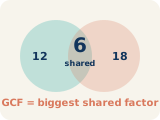
Máximo común divisor
The greatest whole number that divides two or more numbers with no remainder.
El mayor número entero que divide dos o más números sin dejar residuo.
📌 Factors shared by 12 and 18 are 1, 2, 3, and 6, so GCF = 6.
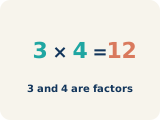
Factor
A factor of a whole number divides it evenly, with no remainder. For example, 3 is a factor of 12 because 12 ÷ 3 = 4.
Un factor de un número entero lo divide exactamente, sin dejar residuo. Por ejemplo, 3 es un factor de 12 porque 12 ÷ 3 = 4.
📌 Factors of 12: 1, 2, 3, 4, 6, 12 — each divides 12 with no remainder
Factor común
A number that divides two or more numbers evenly.
Un número que divide a dos o más números sin que sobre nada.
📌 8 and 12 both divide evenly by 1, 2, and 4 — those are their common factors
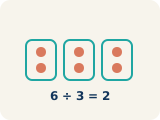
Divisible
A number you can divide evenly, with nothing left over.
Un número que se puede dividir sin que sobre nada.
📌 15 ÷ 3 = 5 with no remainder, so 15 is divisible by 3
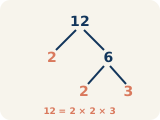
Factorización prima
Writing a number as prime numbers multiplied together. It helps you find the GCF.
Escribir un número como números primos multiplicados. Ayuda a encontrar el MCD.
📌 12 = 2 × 2 × 3 and 18 = 2 × 3 × 3. Shared primes: 2 × 3 = 6 = GCF
Imagine making party bags with the same items in each. Find the GCF of 8 and 12 to see how many equal bags you could make.
Imaginen armar bolsitas de fiesta con los mismos artículos en cada una. Encuentren el MCD de 8 y 12 para ver cuántas bolsitas iguales podrían armar.
Work side by side. You ask questions; your student does the thinking. Trabajen juntos. Tú haces preguntas; tu estudiante piensa.
List the factors of 8: 1, 2, 4, 8. Then the factors of 12: 1, 2, 3, 4, 6, 12.
Escriban los factores de 8: 1, 2, 4, 8. Luego los factores de 12: 1, 2, 3, 4, 6, 12.
Which numbers are in both lists? 1, 2, and 4.
¿Qué números están en las dos listas? 1, 2 y 4.
The largest shared number is 4, so the GCF of 8 and 12 is 4. You could make 4 equal bags.
El número compartido más grande es 4, así que el MCD de 8 y 12 es 4. Podrían armar 4 bolsitas iguales.
Do these together. Start at ★ and climb to ★★★ when ready. Háganlos juntos. Empiecen en ★ y suban a ★★★ cuando estén listos.
What is the GCF of 8 and 12?
A. 4
Which pair of numbers has a GCF of 5?
A. 15 and 25
A teacher has 36 pencils and 48 erasers. She wants to make identical supply bags with no items left over. What is the greatest number of bags she can make?
A. 12 bags
Mission Control must split 24 oxygen tanks and 36 ration packs into identical crew pods with none left over. What is the GCF of 24 and 36?
A. 12
A farmer has 54 apples and 36 oranges. She wants to make gift baskets where every basket has the same number of apples and the same number of oranges, with none left over. Find the greatest number of baskets and explain how you used GCF to solve this.
⏱️ Plan on about 15–20 minutes for the 6 problems below. The extra practice at the bottom is optional. ⏱️ Calculen unos 15–20 minutos para los 6 problemas de abajo. La práctica extra al final es opcional.
A few problems to practice together. Each one has a step-by-step guide, a picture to draw on, and a space to show your work. Use Check This Problem for instant feedback — no need to finish everything at once. Unos problemas para practicar juntos. Cada uno tiene una guía paso a paso, un dibujo para trabajar y un espacio para mostrar el trabajo. Usen Revisar esta pregunta para retroalimentación al instante — no tienen que terminar todo de una vez.
Easier problems to practice the idea. Do these first together. Problemas más fáciles para practicar la idea. Hagan estos primero juntos.
Sort these numbers: which are common factors of 16 and 20, and which are NOT?Clasifica estos números: ¿cuáles son factores comunes de 16 y 20 y cuáles NO lo son?
👪 On a phone, use Move to. On a computer, drag cards or tap a card then tap a column.👪 En el teléfono usen Mover a. En la computadora arrastren o toquen tarjeta y columna.
💡 A common factor must divide 16 with no remainder AND divide 20 with no remainder. One miss means it's not common.Un factor común debe dividir a 16 sin residuo Y dividir a 20 sin residuo. Si falla en uno, no es común.
💡 Test each card twice: divide 16 by the number, then divide 20 by it. Both divisions must come out even.Prueba cada tarjeta dos veces: divide 16 entre el número y luego divide 20 entre él. Las dos divisiones deben ser exactas.
💡 Try the card '8': 16 ÷ 8 = 2 works, but 20 ÷ 8 = 2.5 does not — so 8 is NOT a common factor. Test each other card the same way.Prueba la tarjeta '8': 16 ÷ 8 = 2 funciona, pero 20 ÷ 8 = 2.5 no, así que 8 NO es factor común. Prueba las demás igual.
Use prime factorization to find the GCF.Usa la factorización prima para encontrar el MCD.
👪 Encourage your student to show work on paper if a box feels tricky.👪 Animen a mostrar el trabajo en papel si una casilla se siente difícil.
| Numbers | Prime Factorization | Shared Prime Factors | GCF |
|---|---|---|---|
| 18 and 24 | 18 = 2 × 3 × 3, 24 = 2 × 2 × 2 × 3 | 2 × 3 |
|
| 30 and 45 | 30 = 2 × 3 × 5, 45 = 3 × 3 × 5 | 3 × 5 |
|
| 28 and 42 | 28 = 2 × 2 × 7, 42 = 2 × 3 × 7 | 2 × 7 |
|
The astronaut crew has 40 solar cells and 60 battery cells to load into matching storage bins with nothing left over. What is the GCF of 40 and 60?La tripulación de astronautas tiene 40 celdas solares y 60 celdas de batería para guardar en contenedores iguales sin que sobre nada. ¿Cuál es el MCD de 40 y 60?
👪 Read the question together, then let your student pick an answer before you discuss why.👪 Lean la pregunta juntos; dejen que su estudiante elija antes de hablar del porqué.
Try these once the warm-up feels easy. It's okay to use the steps and pictures. Intenten estos cuando el calentamiento sea fácil. Está bien usar los pasos y los dibujos.
A farmer has 54 apples and 36 oranges. She wants to make gift baskets where every basket has the same number of apples and the same number of oranges, with none left over. Find the greatest number of baskets and explain how you used GCF to solve this.Una agricultora tiene 54 manzanas y 36 naranjas. Quiere armar canastas de regalo donde cada canasta tenga la misma cantidad de manzanas y la misma cantidad de naranjas, sin que sobre nada. Encuentra la mayor cantidad de canastas y explica cómo usaste el MCD para resolverlo.
👪 A complete sentence with math vocabulary is the goal — not a perfect paragraph.👪 Una oración completa con vocabulario matemático es la meta — no un párrafo perfecto.
Each crew pod needs the same number of each supply with none left over. Match each supply pair to the greatest number of equal pods (the GCF).Cada cápsula de la tripulación necesita la misma cantidad de cada suministro, sin que sobre nada. Une cada pareja de suministros con la mayor cantidad de cápsulas iguales (el MCD).
👪 Say each term out loud, then talk through which match makes sense before choosing.👪 Digan cada término en voz alta y hablen de cuál pareja tiene sentido antes de elegir.
A teacher has 36 pencils and 48 erasers. She wants to make identical supply bags with no items left over. What is the greatest number of bags she can make?Una maestra tiene 36 lápices y 48 borradores. Quiere armar bolsas de materiales idénticas sin que sobre nada. ¿Cuál es la mayor cantidad de bolsas que puede armar?
👪 Read the question together, then let your student pick an answer before you discuss why.👪 Lean la pregunta juntos; dejen que su estudiante elija antes de hablar del porqué.
Optional. Only if your student wants more — these are bonus problems. Opcional. Solo si tu estudiante quiere más — son problemas adicionales.
Match each pair of numbers to their GCF.Une cada pareja de números con su MCD.
👪 Say each term out loud, then talk through which match makes sense before choosing.👪 Digan cada término en voz alta y hablen de cuál pareja tiene sentido antes de elegir.
Sort: which pairs have a GCF greater than 1, and which are relatively prime (GCF = 1)?Clasifica: ¿cuáles parejas tienen un MCD mayor que 1 y cuáles son primos entre sí (MCD = 1)?
👪 On a phone, use Move to. On a computer, drag cards or tap a card then tap a column.👪 En el teléfono usen Mover a. En la computadora arrastren o toquen tarjeta y columna.
💡 Each card already tells you its GCF — read it closely. 'Relatively prime' simply means the GCF equals exactly 1.Cada tarjeta ya dice su MCD; léela con cuidado. 'Primos relativos' simplemente significa que el MCD es exactamente 1.
💡 Sort by the printed GCF: a GCF of exactly 1 goes to Relatively Prime; any GCF bigger than 1 goes to the other group.Clasifica por el MCD impreso: un MCD de exactamente 1 va a Primos Relativos; cualquier MCD mayor que 1 va al otro grupo.
💡 Take '8 and 12 (GCF = 4)': 4 is greater than 1, so it belongs in the GCF Greater Than 1 group. Sort the rest by their printed GCF.Toma '8 y 12 (MCD = 4)': 4 es mayor que 1, así que va al grupo MCD Mayor Que 1. Clasifica las demás por su MCD impreso.
Mission Control is packing supply pairs into equal pods. Sort each pair by the largest number of equal pods it can fill (its GCF).Control de Misión está empacando parejas de suministros en cápsulas iguales. Clasifica cada pareja según la mayor cantidad de cápsulas iguales que puede llenar (su MCD).
👪 On a phone, use Move to. On a computer, drag cards or tap a card then tap a column.👪 En el teléfono usen Mover a. En la computadora arrastren o toquen tarjeta y columna.
💡 The two labels already give you the answers: every card's GCF is either 5 or 6, so you just have to figure out which.Las dos etiquetas ya te dan las respuestas: el MCD de cada tarjeta es 5 o 6, así que solo tienes que decidir cuál.
💡 For each card, find the largest number that divides both supply counts evenly, then drop the card under the label that shows that number.Para cada tarjeta, busca el número más grande que divide exactamente a las dos cantidades y colócala bajo la etiqueta que muestra ese número.
💡 Take '15 tanks & 25 packs': the factors of 15 are 1, 3, 5, 15. Check which of those also divide 25 evenly to find its pod count.Toma '15 tanks & 25 packs': los factores de 15 son 1, 3, 5, 15. Revisa cuáles de esos también dividen exactamente a 25 para hallar su número de cápsulas.
What is the GCF of 8 and 12?¿Cuál es el máximo común divisor (MCD) de 8 y 12?
👪 Read the question together, then let your student pick an answer before you discuss why.👪 Lean la pregunta juntos; dejen que su estudiante elija antes de hablar del porqué.
Which pair of numbers has a GCF of 5?¿Cuál pareja de números tiene un MCD de 5?
👪 Read the question together, then let your student pick an answer before you discuss why.👪 Lean la pregunta juntos; dejen que su estudiante elija antes de hablar del porqué.
What is the GCF of 14 and 21?¿Cuál es el MCD de 14 y 21?
👪 Read the question together, then let your student pick an answer before you discuss why.👪 Lean la pregunta juntos; dejen que su estudiante elija antes de hablar del porqué.
What is the GCF of 9 and 15?¿Cuál es el MCD de 9 y 15?
👪 Read the question together, then let your student pick an answer before you discuss why.👪 Lean la pregunta juntos; dejen que su estudiante elija antes de hablar del porqué.
Find the GCF of each pair, then use it to simplify the fraction.Encuentra el MCD de cada pareja y úsalo para simplificar la fracción.
👪 Encourage your student to show work on paper if a box feels tricky.👪 Animen a mostrar el trabajo en papel si una casilla se siente difícil.
| Fraction | GCF of Numerator & Denominator | Simplified Fraction |
|---|---|---|
| 12/18 | 6 |
|
| 20/30 | 10 |
|
| 24/36 | 12 |
|
| 15/25 | 5 |
|
A digital scratch pad to draw models, line up decimals, and show your work. It opens in a new tab so you keep your place on this homework. Una pizarra digital para dibujar modelos, alinear decimales y mostrar el trabajo. Se abre en una pestaña nueva para no perder tu lugar en esta tarea.
🧮 Open the Math Workbench ↗ 🧮 Abrir la Pizarra de matemáticas ↗
Let's list all the factors of each number first. What divides it evenly?
Escribamos primero todos los factores de cada número. ¿Qué lo divide sin que sobre nada?
Which factors show up in both lists? Those are the common ones.
¿Qué factores aparecen en las dos listas? Esos son los comunes.
Of the shared factors, which is the biggest?
De los factores compartidos, ¿cuál es el más grande?
Just multiply the two numbers together to get the GCF.
Solo multiplica los dos números para obtener el MCD.
Any common factor works as the answer.
Cualquier factor común sirve como respuesta.
The GCF can be bigger than the numbers themselves.
El MCD puede ser más grande que los propios números.
These links go to specific videos and lessons about tonight's topic — not general math pages. Estos enlaces van a videos y lecciones específicas sobre el tema de hoy — no páginas generales.
Reinforce tonight's topic with a quick family game. You ask; your student decides! Refuercen el tema de hoy con un juego rápido en familia. ¡Ustedes preguntan; su estudiante decide!
🎮 Play together! Break numbers apart until only primes remain. 🎮 ¡Jueguen juntos! Descompongan hasta que solo queden primos.
High five! Whether every answer was perfect or not, you showed up for your student tonight. That matters.
¡Chócalas! No importa si cada respuesta fue perfecta — estuviste con tu estudiante esta noche. Eso importa.
Answers save automatically on this device. Tap Check This Problem anytime. Las respuestas se guardan solas en este dispositivo. Toquen Revisar esta pregunta cuando quieran.
Signed on:Firmado el:
Note to teacher / Nota para el maestro:
This certifies that the homework for was completed and reviewed collaboratively.
Parent/Guardian Signature
Date